E Invoicing in Saudi Arabia

E Invoicing in Saudi Arabia

Bookkeeping Firms

E Invoicing in Saudi Arabia

With growing economic concerns, one of the toughest struggles a country faces today is handling tax fraud and the shadow economy. But thanks to the latest technology, a digital method that aids in combating tax evasion is the use of electronic invoicing. Just like every other growing country, KSA is also working progressively to enforce e-invoicing mandates for almost every business operating in the Kingdom, regardless of its scale. The goal is to tackle the tax misrepresentation, along with creating a system that is transparent, modern, and aligned with global initiatives. The official authority that oversees e-invoicing enforcement and policies in KSA is the Zakat, tax, and Customs Authority (ZATCA), which ensures that every entity must obey the e-invoicing compliance in Saudi Arabia. Therefore, in this day and age, if you are operating in KSA or planning to start a venture, understanding E-invoicing compliance in KSA is no longer merely a technical upgrade, but a legal and strategic necessity.

500+ Satisfied Clients
35+ Expert Accountants
4 International Offices
8 Custom Solutions

Introduction

Paper invoicing has been discouraged for decades now, and businesses mostly rely on automation tools and software to create and manage their invoices. To further modify the creation, storage, and generation of invoices, more businesses and governments around the world have started turning to e-invoicing, which is taking center stage as the next innovation in tax accounting, auditing, and reporting.

E-invoicing utilizes a standardized format and fully automated systems, which are compatible across different systems, unlike traditional PDF or paper-based invoices that are prone to manual labor errors. E-invoicing is mostly regulated and follows strict compliance standards. E-invoicing compliance in Saudi Arabia also follows uncompromising policies that are mandatory for businesses to execute, to operate without any legal stumbling block.

Objectives and key benefits of the e-invoicing Systems

E-invoicing is becoming increasingly popular among businesses and authorities due to the benefits that come with it. E-invoices cover all the same information that a traditional invoice would have, like the reference person, company name, invoice number, tax ID, etc., but in a digital format that is readable by machines as well. E-invoicing helps the authorities in validating the invoices in real time to reduce tax scams and impose compliance. Some of the perks that it offers for businesses we’ll discuss here:

  • E-invoices are more accurate and speedier in comparison with traditional invoices, which remain a labor-intensive process and are plagued with errors
  • It facilitates creating transparent records that are available round the clock, which helps in strengthening better relationships with suppliers, buyers, and stakeholders
  • E-invoices are less burdensome to track, store, and process, which helps in overall elevating the proficiency of business financial operations.
  • The costs of printing and mailing paper invoices are eliminated, and the amount of time spent on creating reports and auditing is also reduced.
  • Through the e-invoicing compliance KSA, you contribute to the nation’s goals towards economic innovation and fostering an accountable legal economy

What is E-invoicing?

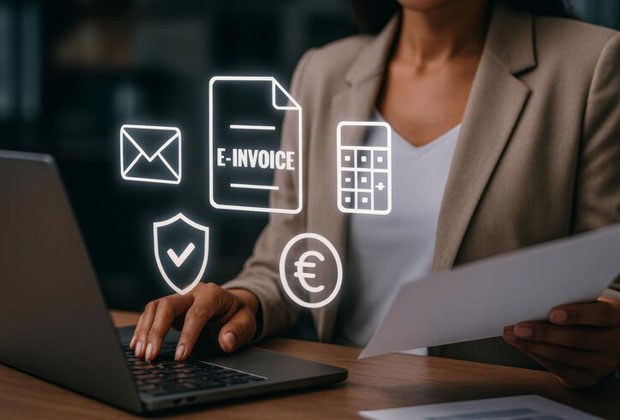
Electronic invoicing is an exchange of invoice information between the supplier and buyer in a digitally structured format. Through this process, invoices are processed, sent, and received via electronic platforms that are merged on the cloud with the legal ZATCA authority. The legal guidelines presented by ZATCA for e-invoicing compliance in KSA include:
  • Creating and generating e-invoices in XML formats that are machine-understandable
  • Including all necessary details like VAT number, invoice information, total amount, and VAT amount.
  • Must utilize the compliant systems and software that are issued by the ZATCA.
Financial Risk Advisory Services
  • Every invoice must include a unique identifier (UUID) for tracking
  • Add all required security components, including e-stamps, digital signatures, and barcodes where required
  • You may issue your invoices in a foreign language, but Arabic must be added where applicable
  • Deletion, alteration, or invoice tampering is explicitly disallowed and results in strict legal consequences
  • Archive each invoice electronically for at least 6 years in case of any audit trail

ZATCA charges hefty penalties in case of non-compliance with these legal obligations. To operate in the Kingdom with complete legal security, e-invoicing compliance is vital for regulatory success. Businesses must emphasize their e-invoicing services in Saudi Arabia by implementing optimal approaches or hiring an e-invoicing provider.

How the Saudi Arabia E-Invoicing System Works?

Clearly, the shift towards e-invoicing was a huge move for KSA businesses, particularly the traditional ones. Therefore, ZATCA rolled it out in 2 separate phases, setting a preparatory period which made it easier for businesses to adopt and implement e-invoicing practices across their systems and teams.

  1. The first phase, which was the generation phase, mainly demanded just the creation and storage of invoices digitally using the eligible software and systems. These e-invoices were also required to include all mandatory information (QR codes, e-stamps, etc.) with structured formats (XML), and paper invoices were no longer allowable.
  1. The second integration phase was a more mature compliance system, where businesses were required to integrate their invoicing systems with ZATCA’s platform. Through these consolidated systems, ZATCA authorities are able to verify all invoices in real time or near real time, depending on the type of invoice.

The QR codes and e-stamps validate the authenticity of the invoices and cover all the necessary additional information. This also helps in preventing invoice tampering and upholding data integrity standards. In summary, the purpose in to build continues digitally innovated system of invoicing from generation to approval and archiving. Today, companies that address these requirements proactively are not only on the right side of the law but also benefit from more competent, transparent, and sustainable workflows.

Which Taxpayers Are Subject to E-Invoicing in Saudi Arabia?

E-invoicing services in Saudi Arabia are far-reaching in scope and cover a range of taxpayers, making it an all-encompassing requirement of compliance. The system initially prioritized all VAT-registered companies, but later it expanded across different scales of businesses. Today, under the ZATCA’s obligations, e-invoicing compliance in KSA is applied to:

  • All businesses that are registered for VAT in Saudi Arabia, irrespective of their size
  • Entities that charge a payment or bill for their goods and services
  • Any third party that issues their invoice on behalf of the taxpayer, such as accounting firms, etc.

E-invoicing laws do not impact the non-resident taxpayers or the individual services that are not registered for VAT compliance in KSA. That being said, every business must thoroughly analyze its operations to determine if they fall under the e-invoicing compliance in Saudi Arabia. Neglecting VAT compliance results in adverse legal impacts in the form of penalties.

What Transactions Are Covered?

A diverse set of transactions is covered for e-invoicing compliance, which is to help the country in a traceable and digitally aligned system across the Kingdom. The main transactions listed for e-invoicing compliance in KSA are highlighted below:

  • Business-to-Business (B2B): All the transactions and invoices exchanged between businesses to businesses are enforced with e-invoicing laws. These invoices are required to be cleared and verified by ZATCA in real time. These invoices must have all the required components to ensure clarity among the trading partners
  • Business to Consumer (B2C): All transactions between consumers and businesses are subject to e-invoicing compliance regulations. They must issue simplified invoices that are less detailed and easier to adhere to. These invoices include QR codes and are provided with a time frame by ZATCA for validation.
  • Export of Goods and Services: The goods and services that are exported fall under the zero-rated VAT category, but they are subject to the e-invoicing laws. This is to ensure proper documentation of every financial transaction with maintained records and transparency.
  • Credit/Debit Notes: Any payments that are made in advance or credit and debit notes are also a part of the mandatory e-invoicing laws. They must issue their invoices in the right electronic formats to also keep reliable financial data.

Pinpointing in-scope transactions gives companies the ability to implement the best e-invoicing solutions across their teams, systems, and operations.

Preparing for E-Invoicing in Saudi Arabia: Key VAT Law Amendments 200

The introduction of e-invoicing in Saudi Arabia was a planned and calculated step to encourage law-abiding operations across the Kingdom. ZATCA carefully designed statutory guidelines to mandate the issuance of electronic invoices among all businesses. These legal Amendments underlined the following areas:

  1. All the invoices must be issued electronically for all of their taxable transactions, and old methods of paper-based or PDF invoices must not be approved. Every business will follow these clear standards and formats.
  2. Businesses have to integrate their systems with the ZATCA platform in real time for non-interrupted communication, submission, and authentication of invoices without any delay.
  3. All the e-invoices should be archived and stored for at least the given period by ZATCA, which is generally for a minimum of 6 years. This aids them in case of any audits or inspections done by legal bodies.
  4. All the security measures, like e-stamps, encryption protocols, and digital signatures, must be included in every invoice to keep it guarded from sensitive data damage and ensure the authenticity of invoices
  5. Companies must not delay in issuing invoices, use non-compliant systems, provide incomplete data, or tamper with invoice data. Otherwise, they will be exposed to harsh legal consequences from the authorities.

These amendments focus on how critical the readiness of the system is for e-invoicing compliance in KSA. Businesses must completely analyze their current systems and take all the precautionary measures, hire new teams, or even get help from the best e-invoicing service provider in Saudi Arabia to ensure that they are always in line with compliance needs.

How to Prepare for Saudi Arabia E-Invoicing

Getting ready for mandatory e-invoicing is important for lawful business operations across the KSA market. The most preferred approaches that you must adopt include:

  • You must carry out compliant e-invoicing solutions and generate your invoices, integrating with ZATCA’s official platforms through protected systems.
  • Train your employees regularly regarding any recent updates in laws and instruct how they can operate the upgraded systems proficiently.
  • Review complete internal processes. If any updates related to business operations or systems are required, you must make the needful changes promptly
  • ZATCA regulations evolve quite frequently; your teams, systems, and operations must also adapt accordingly
  • Look for a professional e-invoicing service provider; they have years of expertise in local e-invoicing compliance; hence, they guide you in the best way possible.

SSCOKSA has been offering its exclusive e-invoicing services in KSA, unmatched by any local competitors. With the expert supervision and the implementation of top-notch compliance tools, we guarantee you that you will always be guarded from any legal non-compliance damages. Get in touch today to start a journey toward never-ending compliance and success with SS&Co.

FAQ

Related Insights

Which Countries have Adopted e-invoicing?

Which Countries have Adopted e-invoicing?

Who is applicable for e-invoicing?

Who is applicable for e-invoicing?

Who is required to use e-invoicing?

Who is required to use e-invoicing?

Key Aspects of Saudi E-Invoicing (Fatoora)

Key Aspects of Saudi E-Invoicing (Fatoora)

What countries have mandatory e-invoicing?

What countries have mandatory e-invoicing?

Is e-invoicing mandatory in Saudi Arabia?

Is e-invoicing mandatory in Saudi Arabia?